


History of Kumamoto CastleHistory of Kumamoto Castle
Spanning 400 years,
the Splendid and Stormy History
of Kumamoto Castle
The iconic Kumamoto castle that we see today was completed in 1607 by Kato Kiyomasa, the first daimyo (feudal lord) of the castle, with great effort and the latest technology.
Since then, Kumamoto Castle has set the stage for the stories of a variety of significant heroes spanning 400 years of Japan's history. The Hosokawa clan, swordmaster Miyamoto Musashi, and Imperial Army commander Tani Tateki are just some of the heroes who have carved their names on the tablet of the castle's dramatic history.
So sit back and relax as we take you back to Kumamoto Castle as it was, up until today, on a journey spanning 400 years.
Founding Daimyo of Kumamoto Castle Kato Kiyomasa
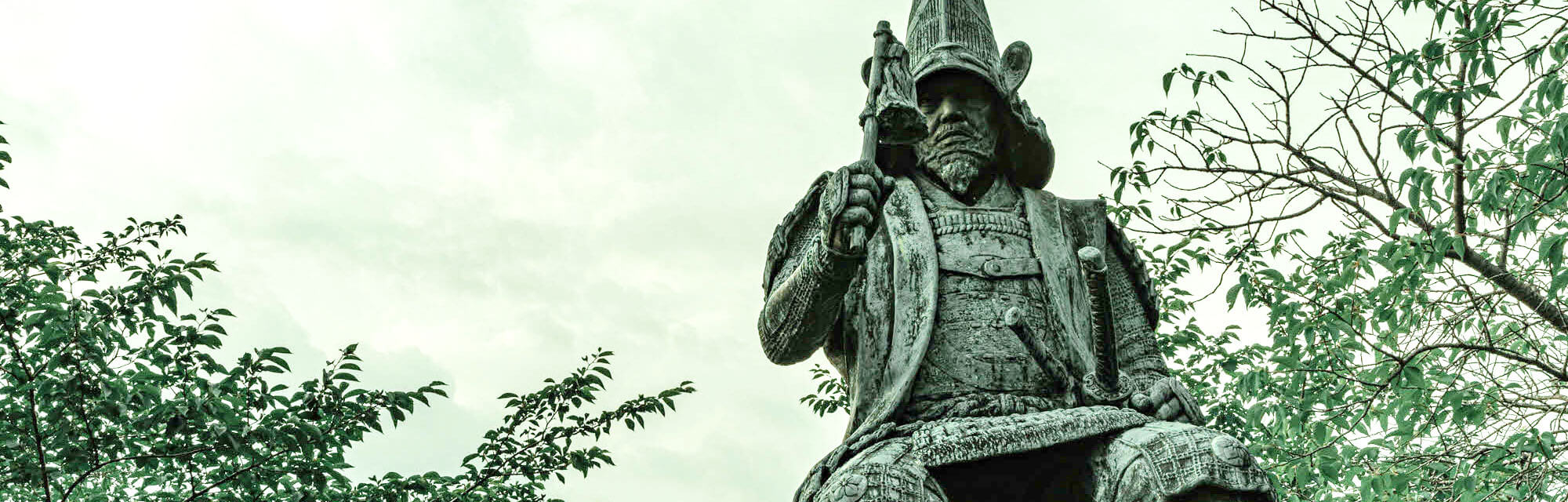
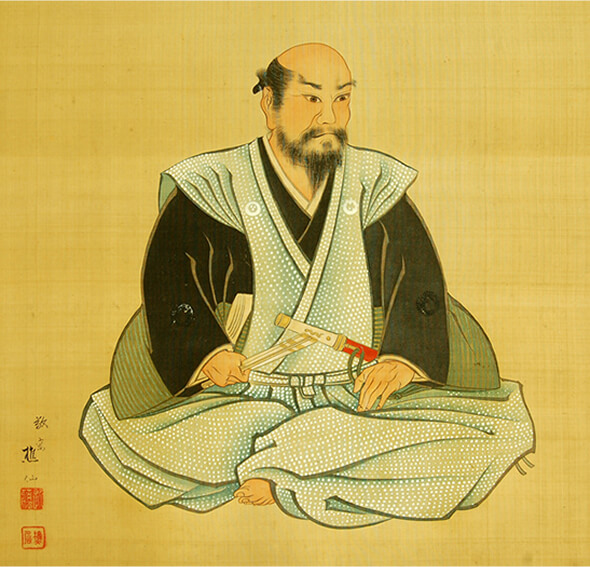
Kato Kiyomasa (1562-1611), the daimyo (feudal lord) who ordered the construction of Kumamoto Castle, arrived in Higo Province (now Kumamoto prefecture) at the age of 27. Coming from Owari, in the western part of present-day Aichi Prefecture, it is said that his mother was a cousin to the mother of Toyotomi Hideyoshi, the shogun who unified Japan at the end of the 16th century.
In order to rise from the ruins caused by prolonged warfare, after arriving in Higo, Kiyomasa worked hard on forest conservation and flood control projects, as well as developing rice fields. Meeting with great success, these civil engineering projects still exist today. Through Japanese trade with Portugal and Spain during the 16th and 17th centuries, he enriched Higo Province by actively managing his dominion. As a result, the people of his dominion loved him so much that even today, Kumamoto residents affectionately call him, "Seishoko-san"(Prince Kiyomasa).
Hosokawa Tadatoshi, 3rd Daimyo of Kumamoto Castle
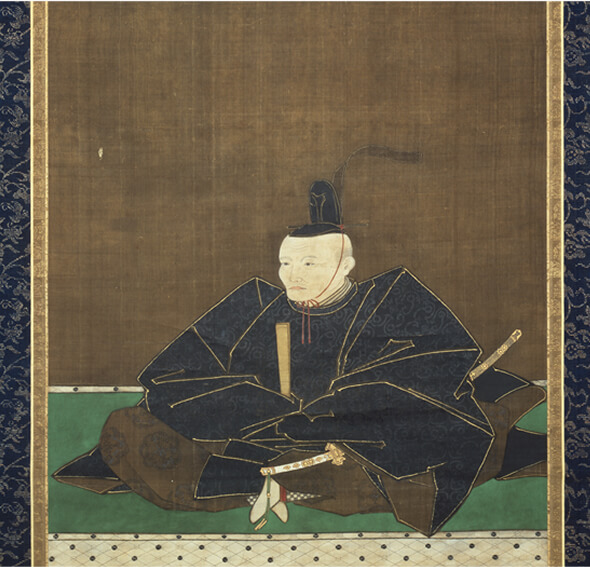
After two generations of serving as the feudal lords of Kumamoto Castle, the Kato Clan were removed from power, and were replaced by Hosokawa Tadatoshi, who entered Higo Province after serving as the daimyo of Kokura Castle in Bunzen Province. He came from Hosokawa, a clan of daimyo who had gone through the Sengoku Period, serving shoguns Oda Nobunaga (1534-1582), Toyotomi Hideyoshi (1537-1598), and Tokugawa Ieyasu (1534-1616).
Hosokawa Tadatoshi's grandfather, Yusai, gained recognition as the foremost person of culture at the time. A disciple of master Sen no Rikyu (1522-1591), his father, Tadaoki, was known as a master of the tea ceremony. Inheriting such a lineage, Tadatoshi was a man of culture who also excelled in martial arts. It was Tadatoshi who invited Miyamoto Musashi (1584-1645), one of Japan's most famous samurai, to spend his final years in Kumamoto.
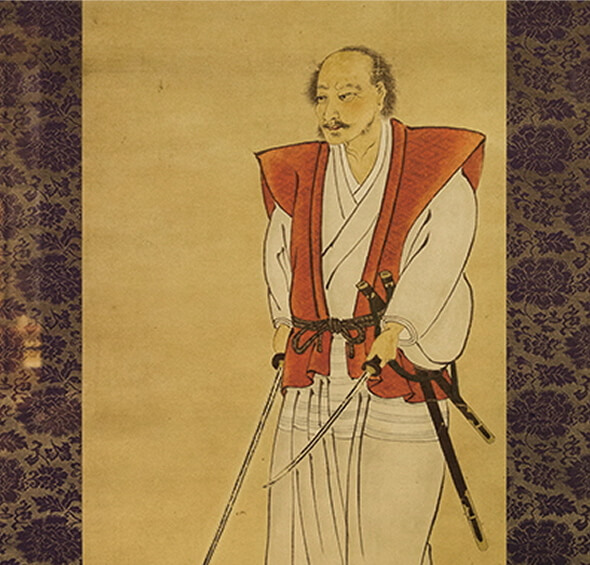
Miyamoto Musashi
Known overseas as the author of The Book of Five Rings, Miyamoto Musashi was a master swordsman of the Edo Period. In 1640, at the age of 57, it is said that feudal lord Hosokawa Tadatoshi invited him to spend his later years in the area of what is now Chibajo-machi. In Kumamoto, Musashi founded the Niten Ichiryu, an ancient school of thought regarding swordsmanship practices, which continues to be implemented today in the more modern school of thought, Nitoryu. He also spent his final days absorbing art and culture, studying Zen, the Way of Tea, and calligraphy. His works are housed at the Shimada Museum of Arts in Kumamoto and the Eisei Bunko Museum in Tokyo.
The Satsuma Rebellion and Tani Tateki
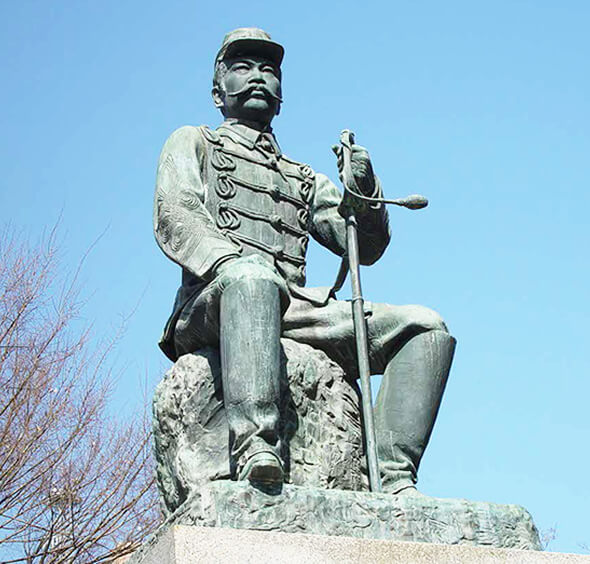
During the Satsuma Rebellion of 1877, Kumamoto castle experienced its first taste of modern warfare, when a fifty-day siege was staged. Inside the castle, a garrison of 3500 soldiers commanded by Major General Tani Tateki fought against the Satsuma Army of 13,000. Kumamoto Castle demonstrated, in name and reality, that it was an impregnable fortress.
As the war was starting, the Tenshukaku main tower and Honmaru Goten palace were enveloped in flames. Several theories exist, including arson and accident, but even now, no specific cause has been determined.
Stone monuments and bronze statues related to the Satsuma Rebellion, can be seen in Kumamoto Castle's Ninomaru Park and Takahashi Park. Enjoy exploring Kumamoto for traces of history pertaining to the soldiers of the Meiji Period (1868-1912).
Kumamoto Castle's Chronology
| Tensho 16 (1588) | Kato Kiyomasa arrives as the feudal lord of the former Kumamoto Castle with a domain of 195,000 goku of rice. |
|---|---|
| Tensho 18 (1590) | Work starts on reforming an early Kumamoto Castle |
| Keicho 4 (1599) | Work starts on expanding Kumamoto Castle on Chausuyama Plateau. |
| Keicho 5 (1600) | The Battle of Sekigahara Around this time, the main castle tower is completed. |
| Keicho 12 (1607) | Construction on the new Kumamoto Castle is completed. The Chinese character of the castle's name is changed. |
| Keicho 16 (1611) | Kiyomasa dies at the age of 49. His son Tadahiro becomes the second daimyo of Kumamoto. |
| Kanei 9 (1632) | The Kato Clan are removed from power, and Hosokawa Tadatoshi takes over the Higo Domain. |
| Kanei 17 (1640) | Tadatoshi invites Miyamoto Musashi to Higo (Kumamoto) and gives him a residence in the present-day Chibajo-machi. |
| Horeki 5 (1755) | Hanko-Jishukan (Jishukan domain school) is opened in Ninomaru. |
| Meiji 4 (1871) | Feudal domains are abolished and prefectures are established. |
| Meiji 7 (1874) | The castle grounds are incorporated as an army base, and the garrison headquarters are moved to the Honmaru. |
| Meiji 9 (1876) | The Shinpuren Rebellion breaks out against the Meiji government. |
| Meiji 10 (1877) | The Satsuma Rebellion breaks out. The castle towers and the Honmaru Goten Palace burn down in a fire. |
| Meiji 22 (1889) | Damage is sustained by the Kumamoto Earthquake (Mount Kinbo earthquake). |
| Showa 8 (1933) | Uto-Yagura Tower and 12 other turrets are named national treasures, while the stone walls and moats are designated as historic sites. |
| Showa 25 (1950) | Kumamoto Castle is renamed from a National Treasure building to an Important Cultural Asset. |
| Showa 30 (1955) | Kumamoto Castle is designated as a Special Historical Site |
| Showa 35 (1960) | Tenshukaku (main castle tower and small castle tower) are reconstructed with steel-framed reinforced concrete. |
| Heisei 10 (1998) | Work begins on reconstructing Kumamoto Castle. |
| Heisei 28 (2016) | Damage is sustained by another Kumamoto Earthquake. |
| Heisei 29 (2017) | Work starts on repairing Kumamoto Castle's Tenshukaku. |
| Reiwa3(2021) | Kumamoto Castle Tenshukaku(castle towers) are fully reconstructed. |
Highlights of Kumamoto Castle
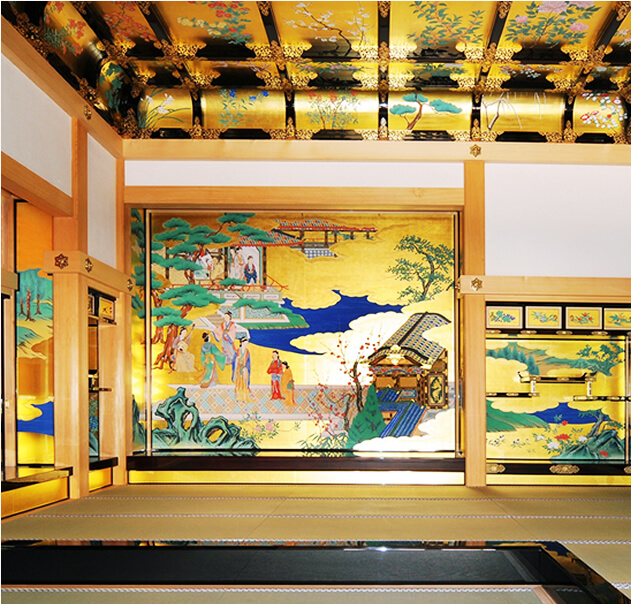
The Secret of Shokun-no-Ma
In 2007, Kumamoto Castle marked a turning point in its history. To commemorate the 400th anniversary of its construction, reconstruction was completed on the Honmaru Goten Great Hall. By taking clues from excavated illustrations and documents from the Edo Period (1603-1868), as well as photographs taken at the beginning of the Meiji Period (1868-1912), the Honmaru Great Hall could be reconstructed to its Edo Period condition.
Inside the Honmaru Goten, the most formal room was said to be Shokun-no-Ma. On the walls and sliding doors, the tragic story of Wang Zhaojun (O shokun in Japanese), a beauty who lived in China during the former Han dynasty, is depicted. Actually, there is a theory that Kato Kiyomasa had prepared this room to welcome Hideyori, the orphaned son of shogun Toyotomi Hideyoshi. The room was named Shokun-no-Ma, referring to the princess whose story can be found on the walls of the room. It is said that Shoukun is a hononym for Shogun.
* Due to damage from the 2016 Kumamoto Earthquake, the Honmaru Goten Great Hall is not open to the public at this time.
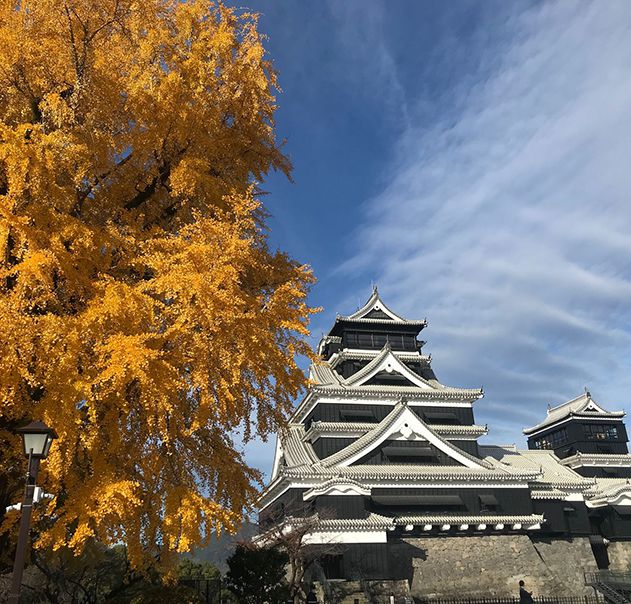
Also Known as the "Ginkgo Castle"
At the Tenshukaku-Mae Hiroba, there is a ginkgo tree which gave Kumamoto Castle its nickname, Ginnan-jo, meaning "ginkgo castle". This tree and another ginkgo tree located on the grounds of Kato Shrine, are said to have been planted by Kato Kiyomasa himself. However, in 1877, right before the Satsuma Rebellion, when the main tower and the Honmaru Goten palace were destroyed by fire, that ginkgo tree was also destroyed in the fire. The current ginkgo tree grew from a seedling planted after the fire.
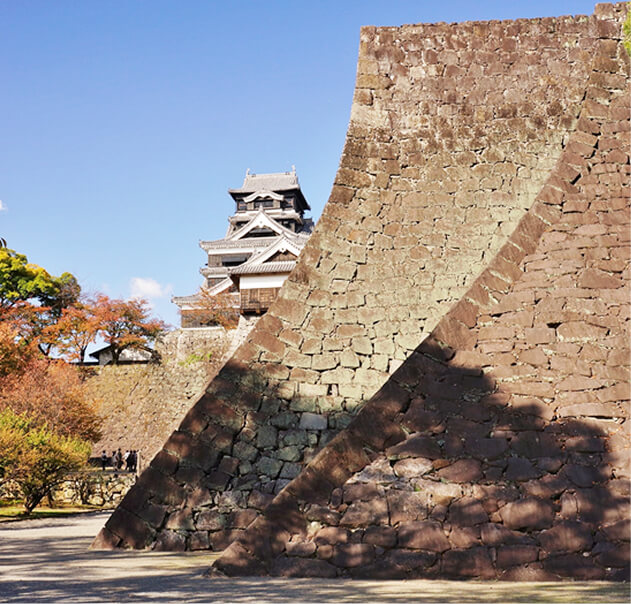
Even Ninjas Can't Climb the Musha-Gaeshi
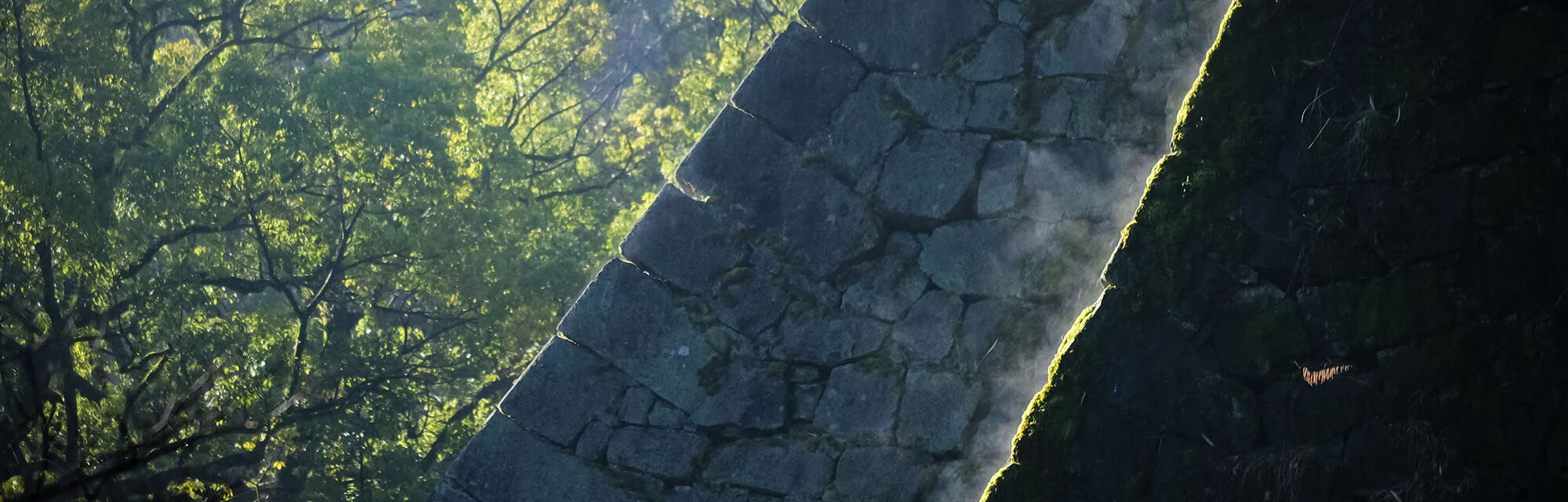
Kumamoto Castle's stone walls are nicknamed Musha-gaeshi. These stone walls are one of the most distinctive features of Kumamoto Castle. While the bottom of the castle walls appear to be easy to climb, the higher you go, the steeper the slope turns, and it becomes impossible to reach the top. Not only heavily armored samurai, but even nimble ninjas failed to climb these walls. That's why they are called musha-gaeshi which roughly translates to "warrior repellent".
While the most of the original buildings of Kumamoto Castle were lost in modern times, many of its stone walls have remained intact since their construction. However, in the 2016 Kumamoto Earthquake, the walls suffered damage, including subsidence on the left side.
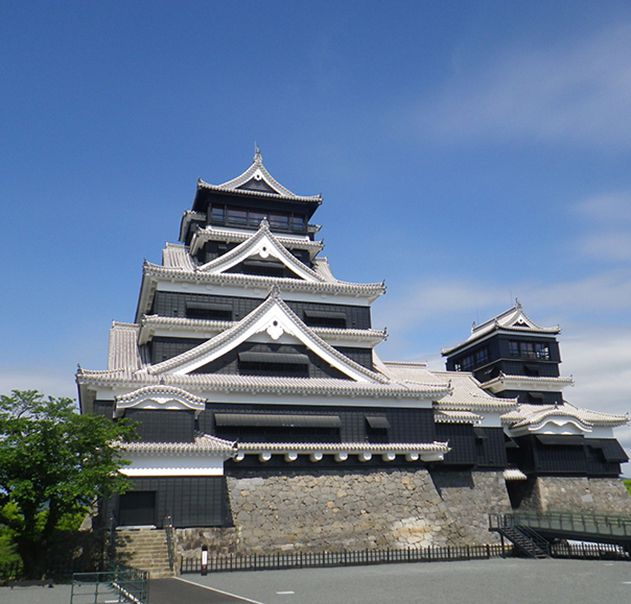
Rebuilding the Castle Towers
Kumamoto Castle once spanned a vast area of about 980,000 square meters. Surrounded by grounds extending about 5.3 kilometers, the castle featured numerous towers of various sizes, including 49 yagura turrets, 18 turret gates, and 29 castle gates. Along with the main castle tower, the majority of these structures were lost in the fire that broke out shortly before the Satsuma Rebellion of 1877. However, Uto-Yagura and a group of turrets called Higashi Takenomaru have remained in their original form since they were built, and these thirteen towers have been designated as National Important Cultural Properties. In 1960, Kumamoto citizens donated funds to rebuild the castle towers from steel-framed reinforced concrete. Based on photographs taken from the early Meiji Period, the exteriors were faithfully reconstructed, down to the number of roof tiles.
Although it was damaged in the 2016 Kumamoto Earthquake, the castle tower was prioritized as a symbol of recovery and fully reconstructed by March 2021. The renewed tower incorporates advanced seismic reinforcement and barrier-free design, along with a complete overhaul of its exhibits and interior. It has been reborn as a safer and more captivating destination.
Facts about Kumamoto Castle
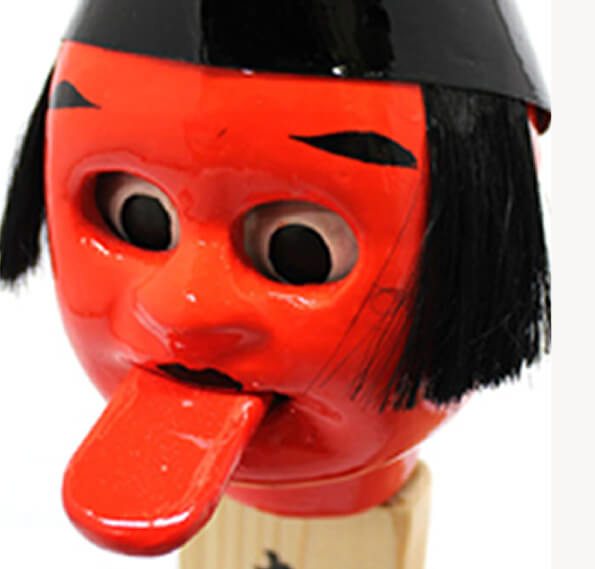
Obake-no-Kinta (Kinta the Ghost)
Among Kumamoto's traditional handicrafts, there is a toy called Obake-no-Kinta, meaning "Kinta the Ghost" . It has a black laquered cone-shaped hat placed on top of a red face with googly eyes. When a string in the back is pulled, the eyeballs roll around and the tongue sticks out, which makes it a popular doll. This traditional toy, Obake-no-Kinta, continues to be made in Kumamoto.
When Kato Kiyomasa built Kumamoto Castle, there was a common foot soldier named Kinta. With his funny features, Kinta always made people laugh, and this popular guy was known as, "joking Kinta". Over time, Kinta became a legendary figure, and this doll is said to have been modelled after him.
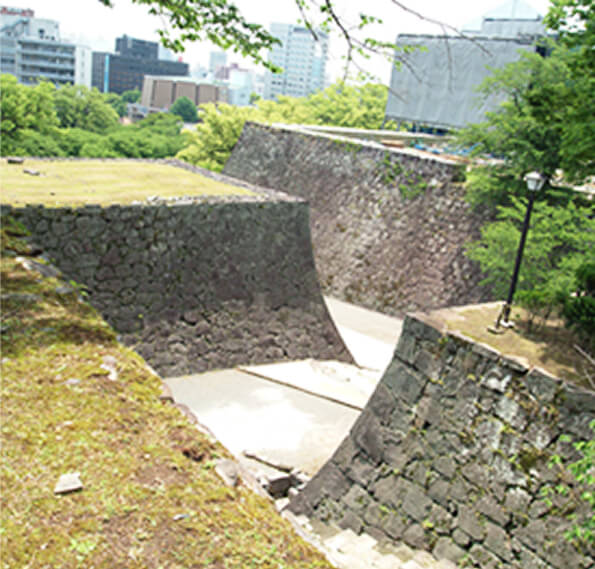
Labyrinth-Like Stone Wall Enclosures
The path from Takenomaru to Iidamaru, winds through six twists. Further along this path in the Edo Period, there was a 5-storied yagura turret (Nishitake-no-maru Gokai-Yagura), which was located at the center of Nishi Takenomaru. Two gates called Fuda-Yagura Gate and Moto Fuda-Yagura Gate were placed at the north and south ends for protection. Surrounded by interconnected stone walls, this ingenious defensive design is one of Kumamoto Castle's most defining characteristics.
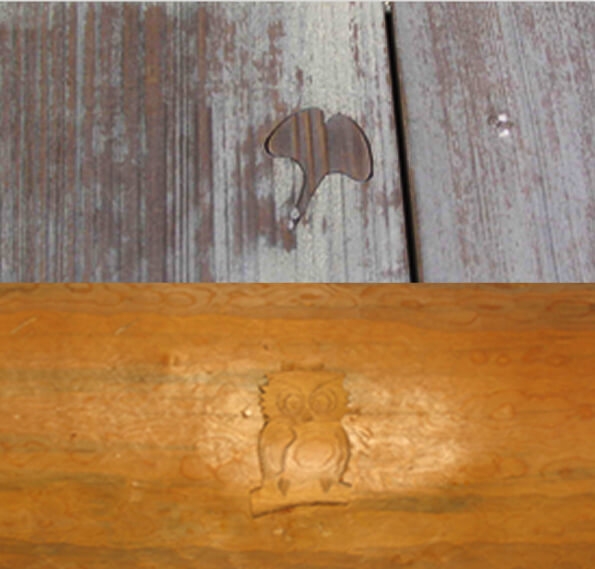
Playful Touches by Castle Carpenters
During the restoration of the Iidamaru Gokai-Yagura, a carpenter carved an owl into one of the beams. What's more, ginkgo tree leaves had been etched into a beam in the Second Floor Large Hall. These carvings show the playful side of the carpenters as they worked on the reconstruction. See if you can spot these hidden carvings! It's trickier than it looks!
* Due to damage from the 2016 Kumamoto Earthquake, Iidamaru Gokai-Yagura is not open to the public.
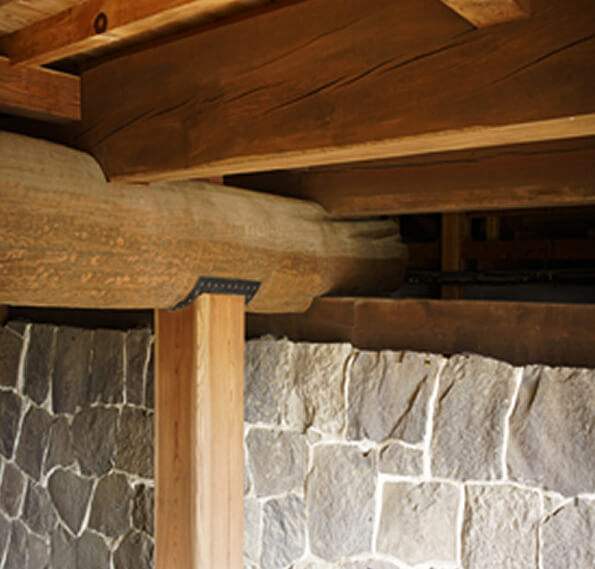
Rippled Planing Marks from the Castle's Original Construction
When Kumamoto Castle was first constructed, the surface of a pillar was roughly shaped using the edge of a hatchet. Traces of this rippled planing can still be seen on a pillar inside the Uto-Yagura turret tell the tale from the time the castle was built. When reconstructing the Honmaru Goten Palace, a specially made hatchet modeled after the original was used, rippled planing marks were intentionally recreated.
* Due to damage from the 2016 Kumamoto Earthquake, Uto-Yagura is not open to the public.
- HOME